
What is a Timeline?
A timeline is like a map of your life’s journey holding all the events that have shaped who you are today.
Negative events or traumas can be stored away in your mind like files on a computer. These “files” influence your thoughts, feelings, and behaviours, sometimes without you even realising it.
By recording these events in a structured way, you can:
- Identify patterns: See if certain types of events consistently lead to negative emotions.
- Gain perspective: Understand how past experiences have shaped your present self.
- Challenge negative beliefs: Reframe negative events in a more positive light.
- Heal from past traumas: Address and process difficult experiences to move forward.

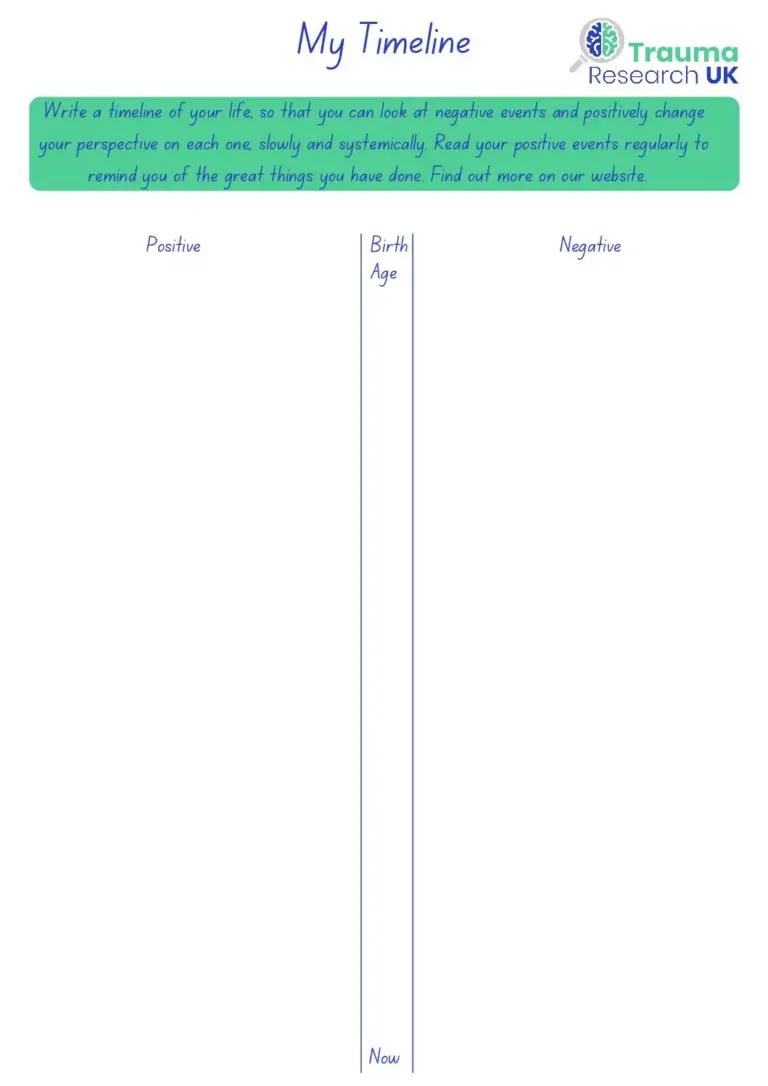
Create Your Timeline
- Create a timeline of your life: Start with your earliest memory and include as many events as possible – Let your thoughts flow and write down everything that comes to mind.
- Identify positive and negative events: Categorise events into these two columns adding your age.
- Positive events might include times you felt happy, things that have brought you joy, times of accomplishment and moments of connection. Negative events might include times when you felt sad, anxious, angry or confused.
- Assess negative events: Assign a score from 0-10 to each negative event to gauge its impact on your current feelings.
- Reframe negative events: If you scored any events 6 or higher, work on changing how you perceive them to reduce their negative impact.
The 5-Step Formula
As you review each event on your timeline, use this 5-step formula to gain a clearer perspective on each event and start to see them in a more objective and less emotional light.
- What happened?
Start by identifying whether the event was personal or just circumstantial. Was it directed at you, or could it have been influenced by someone else’s struggles? - How did you interpret it at the time?
Reflect on your feelings and thoughts about what happened—how you saw the situation in the moment. - Gather the contra-evidence.
Look for facts that challenge your initial interpretation. Is there another explanation for what happened? - See it for what it is and not as it felt at the time.
Step back and view the situation objectively, separating your emotions from the reality of the event. - Become a victor, not a victim.
Focus on growth and resilience by identifying what you’ve learned and how you can move forward stronger.
Read the positive events regularly to remind you of the great things you have achieved seen and experienced. These times will be unique to your life experiences and might include things such as passing your driving test, winning a competition, going somewhere exciting or having memorable celebrations.